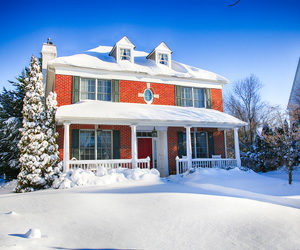
Maryland winters are unpredictable. One week can bring icy rain along the coast, and the next can dump heavy snow in the mountains. According to the Maryland Department of Emergency Management, winter storms across the state often include freezing rain, strong winds, sleet, and sudden temperature swings. That combination puts real stress on homes that are not properly sealed, insulated, or maintained.
Many Maryland homeowners experience the same winter problems every year: cold rooms, higher heating bills, overworked furnaces, frozen pipes, and moisture issues in crawl spaces. These problems usually trace back to a few weaknesses in the home’s building envelope. The good news is that targeted upgrades can make your home warmer, safer, and more efficient before the temperatures drop.
Here are five effective ways to prepare your Maryland home for winter with the help of DeVere Home Performance. These strategies work for both homeowners and builders who want to improve comfort, protect property, and reduce energy costs.
1. Seal Air Leaks
Air sealing is one of the most cost-effective upgrades you can make. ENERGY STAR notes that small gaps and cracks throughout the home can add up to the equivalent of leaving a window open all day. Sealing these openings can reduce heating bills by 10 to 20 percent.
Common air leakage points include:
- Gaps around windows and doors
- Plumbing and wiring penetrations
- Recessed lighting
- Attic access panels
- Rim joists and foundation penetrations
- Chimney and duct chases
Maryland emergency officials recommend adding weatherstripping around operable window sashes and door perimeters and using caulk to seal stationary gaps around frames. Weatherstripping helps prevent cold air from entering the home and reduces pest intrusion. For windows and doors with moving parts, choose high-quality, durable weatherstripping that can handle frequent use.
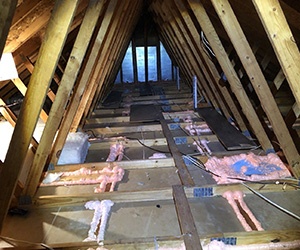
Attic penetrations are among the most significant sources of energy loss in a home. Warm air naturally rises, so any gaps around pipes, wiring, ductwork, recessed lights, or attic hatches become major escape routes. Seal these openings with caulk or foam sealant. Use gasket kits for can lights and attic access doors.
At the foundation level, seal the rim joist and sill plate where the house sits on the foundation. These areas are common sites of cold-air infiltration due to stack effect, when warm air escapes through the top of the home and pulls cold air in from below. Foam sealant works well for the rim joist and utility penetrations, including outdoor spigots and electrical entries.
Maryland code requirements include specific air-tightness levels for new homes. Builders must verify air leakage rates through blower door testing. For existing homes, an energy audit with blower door testing can pinpoint the most significant leaks and provide a clear improvement plan. This is often a simple, low-cost upgrade that results in immediate comfort and savings.
2. Upgrade Attic Insulation
An under-insulated attic is one of the biggest reasons a home struggles to stay warm in winter. Heat rises, so inadequate attic insulation allows warmth to escape directly through the roof. Fixing this is one of the most effective ways to improve comfort and reduce energy costs.
The University of Maryland Extension recommends attic insulation levels of R-49 for this region, with R-60 preferred for maximum efficiency. Maryland’s energy code also sets R-49 as the minimum for new construction ceilings and attic zones in climate zones 4 and 5.
So how much insulation is required to meet these minimums? About 15 to 18 inches of insulation material is required to reach R-49, depending on the type. Approximately 15 inches of fiberglass batt or 13 inches of blown cellulose achieves R-49. Many Maryland homes, including some built within the last 20 years, fall below this level. Blown-in fiberglass or cellulose is often the best upgrade for existing homes because it covers irregular spaces.
Maintain Moisture Control
- Ensure proper attic ventilation; keep soffit vents clear.
- Use baffles to maintain airflow pathways from eaves to ridge.
- A vapor retarder facing the heated space helps reduce condensation,
- Avoid installing multiple vapor barriers, which can trap moisture.
Proper installation paired with adequate ventilation prevents moisture buildup, protects your roof and attic structure, and improves overall winter comfort.
3. Insulate and Seal Your Crawl Space
Cold floors and winter drafts often originate from an unprotected crawl space. Stack effect, which draws cold air in from below and allows warm air to rise, also makes your heating system work harder. Maryland’s mix of humidity and cold weather creates prime conditions for moisture problems, mold, wood rot, and uncomfortable indoor temperatures.
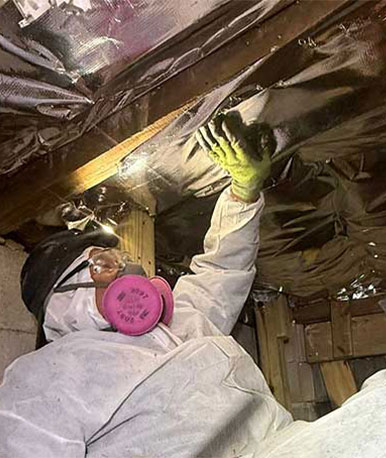 When winterizing your crawl space, the first step is installing a vapor barrier. A continuous layer of durable plastic sheeting over the crawl space floor is essential in Maryland’s climate. It prevents ground moisture from moving into the home and protects insulation from sagging or damage.
Two insulation strategies work for crawl spaces:
Option 1: Encapsulated crawl space (preferred)
- Close off exterior vents.
- Insulate perimeter walls instead of the floor.
- Use foam board or spray foam for a reliable thermal barrier.
- Ensure adherence to Maryland code, which requires continuous insulation from R-10 to R-15 on crawl space walls in unventilated designs.
- Results include warmer floors, reduced humidity, fewer drafts, and lower heating loads.
Option 2: Vented crawl space
- Insulate between floor joists with fiberglass batts to R-19 or R-30.
- Ensure the insulation stays in contact with the subfloor.
- Add a vapor barrier on the ground.
- Insulate rim joists with foam board to stop perimeter drafts.
Regardless of the method, seal all gaps around wiring, plumbing, and ductwork. Insulate any exposed ducts and pipes to prevent heat loss and reduce the risk of frozen lines. For sealed crawl spaces, provide some conditioned air or use a dehumidifier to maintain proper moisture levels. Many professionals favor the sealed-and-insulated method for efficiency and home health.
4. Check and Service Your Furnace
Your heating system carries the biggest load in winter, so a seasonal tune-up is essential. The Department of Energy recommends having the system checked each fall to ensure safe and efficient operation and to avoid mid-season breakdowns.
A professional technician will:
- Inspect burners or heating elements
- Check the heat exchanger for cracks
- Verify proper venting
- Clean components
- Adjust burner and blower settings for efficiency
Homeowners should also:
- Replace filters at least monthly during the heating season. Dirty filters reduce airflow and make the system work harder.
- Keep supply and return vents unblocked.
- Inspect the furnace vent or flue for debris or nests.
- Test smoke detectors and carbon monoxide alarms, especially in bedrooms.
- Make sure the thermostat is programmed for appropriate winter schedules.
Trial your heating system before cold weather is expected. Listen for unusual noises which may denote a failing motor, air in the fuel line, or other issues. Check that the furnace flame is steady blue- if it is flickering or yellow, the burner may have problems and should be checked. Additionally, if your home has ductwork running through an attic or crawl space, sealing those ducts is important. Maryland’s energy code requires duct tightness testing for new duct installations in unconditioned spaces. Sealing duct joints with mastic or foil tape and adding duct insulation can significantly reduce heating losses.
5. Upgrade to LED Lighting
 As the days get shorter, lighting use increases. Switching to LED bulbs is a simple and inexpensive upgrade with immediate savings. According to the Department of Energy, LEDs use up to 90 percent less energy than incandescent bulbs and can last up to 25 times longer.
A standard 8 to 10-watt LED produces the same brightness as a 60-watt incandescent lamp. This translates to significant efficiency and financial savings for residents, as lighting accounts for about 15 percent of a typical home’s electricity use. Many households save around $200 per year by switching to high-efficiency lighting.
LEDs also perform exceptionally well in cold weather, making them ideal for outdoor fixtures, garages, and unheated spaces. Unlike older CFLs, LEDs reach full brightness instantly and do not dim in low temperatures. Modern LEDs come in a wide range of colors, brightness levels, and dimmable options, including smart bulbs. Swapping your home’s lighting to LED results in a quick win- you’ll use less electricity, have less unwanted heat in the house, and save yourself the hassle of changing bulbs for years to come.
Preparing Your Home for a Maryland Winter Does Not Require Major Reconstruction
These five winter preparation strategies work together to make Maryland homes more efficient, safer, and noticeably more comfortable. Sealing drafts, upgrading insulation, improving crawl spaces, maintaining your heating system, and switching to efficient lighting all help reduce energy waste and lower monthly bills. The benefits continue long after winter ends, improving year-round performance and comfort.
If you want help tackling these upgrades, DeVere Home Performance is the go-to expert for Maryland homeowners. Our team installs insulation correctly, performs detailed air sealing, and handles multifamily winterization projects with precision. The best time to prepare is before the first major cold snap. Contact DeVere Home Performance today and get your home ready for the winter weather ahead.
Resources:
Maryland Department of Emergency Management. (n.d.). Winter storms preparedness. State of Maryland. Retrieved from https://mdem.maryland.gov/pages/winter-storms.aspx
Maryland Energy Administration. (n.d.). Your home and the energy code. State of Maryland. Retrieved from https://energy.maryland.gov/documents/yourhomeandtheenergycode.pdf
U.S. Department of Energy. (n.d.). Air sealing guide for contractors. ENERGY STAR. Retrieved from https://www.energystar.gov/sites/default/files/asset/document/DOE_Air%20Sealing%20Guide%20for%20Contractos.pdf
U.S. Department of Energy. (n.d.). Fall and winter energy-saving tips. Office of Energy Efficiency & Renewable Energy. Retrieved from https://www.energy.gov/energysaver/fall-and-winter-energy-saving-tips
U.S. Department of Energy. (n.d.). Lighting choices to save you money. Office of Energy Efficiency & Renewable Energy. Retrieved from https://www.energy.gov/energysaver/lighting-choices-save-you-money
University of Maryland Extension. (n.d.). Home energy insulation. University of Maryland. Retrieved from https://extension.umd.edu/resource/home-energy-insulation